
APPAREL REVIEW:
Various Artists
Future Sounds of Jazz Vol. 16
[Compost Records]
Some records are more than records. They become part of who we are.
Ever since I started collecting CDs, compilations and vinyl records in the vast, fascinating universe of electronic music, there has been one particular series that I have never stopped following: Future Sounds of Jazz, released by the legendary German imprint Compost Records.
I still have a CD copy of the very first volume at home, and I must admit that, looking back at all those years spent digging through record shops, discovering artists, collecting music and eventually establishing my own label, I have come to realise that this series probably influenced me far more than I could ever have imagined. There are certain records that enter your life almost by accident and remain there, quietly accompanying your evolution, without you necessarily recognising their importance until much later. This is certainly one of those cases. Some years ago, I released a compilation on Apparel Music called The Future Sound Of Jazzy Vol. 1. The final Y was no coincidence, of course. It was my own little tribute to something that had been accompanying my musical research for decades, an affectionate reference to a concept that I had somehow absorbed and made my own. At the time, I probably didn't give it too much thought, but today I can see how that title was connected to a much broader idea of music, selection and artistic identity. The word Jazzy, after all, has always represented something rather particular in the Apparel universe, more an attitude or a certain way of approaching sound than a strictly defined musical genre. And if I try to trace that attitude back to some of its earliest influences, I inevitably find myself returning to those extraordinary compilations of the 1990s and early 2000s, when a carefully assembled selection could open up entire musical worlds. There was something special about compilations back then, something that perhaps we took for granted because we were surrounded by them. Today, with a little distance, I believe their real value becomes much clearer. It wasn't simply a matter of putting together excellent tracks, although that was obviously essential. What really made the difference was the person, or the collective intelligence, behind the selection. That invisible thread connecting different artists, different backgrounds and sometimes completely different musical languages into something that suddenly made perfect sense. I have always thought that this is one of the fundamental responsibilities of a record label: providing a filter, an identity, a particular perspective on music. Anyone can assemble a collection of tracks, especially nowadays, but giving that collection a personality, making it recognisable and meaningful, is an entirely different matter.
A great compilation isn't a collection of tracks. It is a point of view.
There is also a rather amusing contradiction surrounding compilations, something I have experienced many times in my own work. From a promotional perspective, they can be incredibly difficult to handle. You don't have a single artist to interview, a particular face to put on the cover of a magazine or an obvious protagonist around whom to build a story. Press offices and promotional agencies often struggle with this kind of release because the usual mechanisms of music communication don't quite apply. Who exactly are you supposed to interview when you have twenty different artists sharing the same record? And yet, paradoxically, compilations can end up being among the most successful and enduring releases in a label's catalogue. I have seen this happen often enough to find it fascinating. Perhaps the explanation is quite simple: people don't necessarily fall in love with a compilation because of the names printed on its sleeve, but because they develop an attachment to the sensibility behind it. They begin to trust whoever is doing the selecting. At that point the compilation stops being a convenient gathering of artists and becomes something with a life of its own, almost a musical destination that listeners return to because they know they will find something worth discovering.
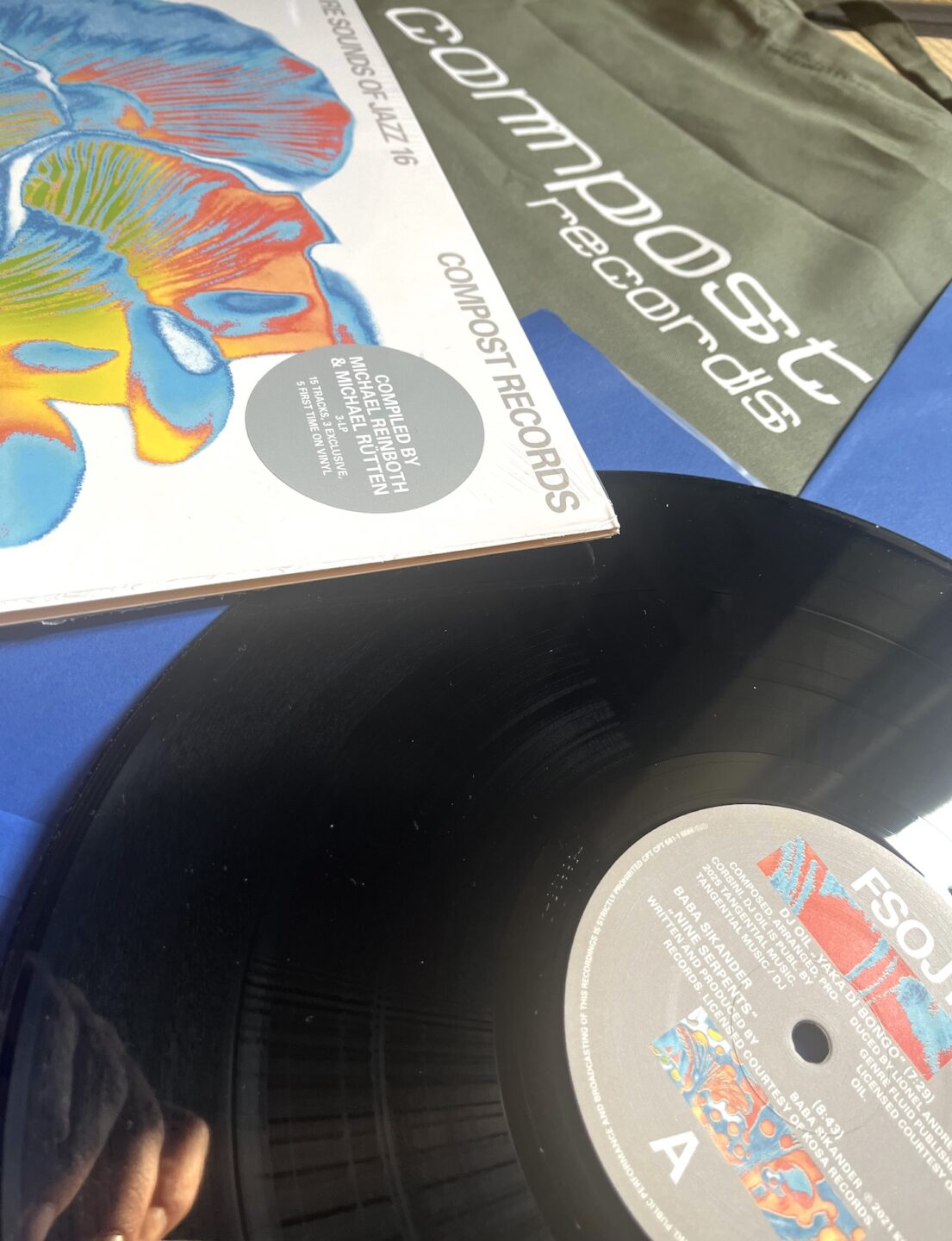 This is precisely what Future Sounds of Jazz has always represented to me, and why receiving Vol. 16, released by Compost Records in September 2026, felt like meeting an old friend who still has plenty of interesting stories to tell. Curated by Michael Reinboth and Michael Rütten, the compilation continues a conversation that began more than thirty years ago, although I don't think either of them is particularly interested in looking backwards. What strikes me about this new volume is how naturally it embraces the different interpretations of contemporary jazz and electronic music without becoming obsessed with defining either of them. There is room for experimentation, spiritual influences, intricate rhythmic constructions, more introspective passages and those wonderfully ambiguous moments when one musical language gradually dissolves into another. It is a selection that demands curiosity, and that is exactly what I expect from a series with this kind of history. The music moves through different atmospheres without feeling obliged to establish a comfortable continuity between every track. Emanative's Om Supreme, in Hector Plimmer's interpretation, offers one possible entrance into this world, while Bitchin Bajas' Amorpha suggests a different, more abstract direction. Brittany Davis' Sun And Moon brings another sensibility into the picture, and Ilhan Ersahin's Istanbul Sessions, revisited by Kaan Duzarat on Birds, adds a further perspective on the relationship between instrumental expression and electronic production. Michael Reinboth's own As If By Magic, Charles Petersohn's Zu Zu Music, featuring Mickey Neher, AdaSoul and Narjara Thamiz, and Beanfield's Catalpa contribute to a collection whose identity emerges progressively rather than announcing itself through a single sound. I like the fact that some tracks seem to belong to entirely different conversations. They make you reconsider the context of what you have just heard, which is often where the most interesting discoveries begin. A compilation doesn't have to please me from beginning to end in exactly the same way. On the contrary, I rather enjoy being challenged by a selection that occasionally takes me somewhere unexpected.
There is, however, another reason why this particular release has already become part of my personal musical history, and it actually precedes the arrival of the physical record. Some time ago, when the advance promotional material first reached me, I happened to be working on the sound curation of an art exhibition here in Milan, the city where I live and where I regularly develop musical environments for exhibitions, installations and other artistic events. I remember going through the tracks and almost immediately finding myself transported into a very particular imaginary space. It is something that happens to me quite often when music genuinely captures my attention: before I have even finished listening, images, associations and possible environments begin to take shape in my head. I start imagining how certain sounds might interact with a room, with the architecture, with the artworks or simply with the movement of people through a space. In this case, the compilation provided precisely that kind of unexpected stimulus, and four tracks in particular ended up becoming part of the sonic environment I was constructing for the exhibition.
The songs were Felix Laband's No Stars Did Glow, Nico Zam's Can You Prove There Is God, Baba Sikander's Nine Serpents and DJ Oil's Yaka Di Bongo. I had selected them almost instinctively, attracted by the different possibilities they seemed to offer, and only afterwards did I begin to understand how they could interact within the wider context of the exhibition. When I work on the sound of an artistic space, I am not simply looking for music that accompanies the visual material. I am interested in how sound can influence the perception of an environment, how it can suggest a mood without imposing one, how it can establish an almost invisible relationship between the artworks and the people experiencing them. Sometimes a particular rhythm can change the way a room feels; at other times, a more suspended or elusive passage can give an image an entirely different emotional weight. It is a delicate process, and one that I find endlessly fascinating, because the music is no longer experienced in isolation. It becomes part of something else, something that exists in a particular place and for a particular moment.
What happened with those four tracks was especially interesting because the original musical selection had already been made by someone else, with an entirely different purpose in mind. Reinboth and Rütten had brought these tracks together as part of their own vision, and months later I found myself using that same material to develop another experience, within another artistic context. I suppose this is one of the most beautiful consequences of sharing music: you never really know where it will end up, or what someone else might decide to create with it. A record can leave a studio, travel through a promotional network, reach somebody sitting in Milan and eventually become part of the atmosphere surrounding an exhibition. There is something rather poetic about that journey, especially when you consider that the entire process began with a compilation, a format that some people still insist on treating as a secondary product.
Music selected with a vision has the extraordinary ability to inspire new visions.
And then there is the physical record itself, which brings me to another rather personal consideration. This time, strangely enough, I didn't have to buy it. After discovering the music through the promotional material, I had the pleasure of receiving a physical copy courtesy of Compost Records, and I couldn't help smiling at the thought. I don't know whether this is the natural consequence of having dedicated so much of my life to researching and sharing music, or perhaps some peculiar form of musical karma finally deciding to return the favour. The truth is that I have spent such an extraordinary amount of money on records over the years that I occasionally prefer not to think about it. Like many collectors, I have accumulated an impressive number of objects that, from a purely practical point of view, I probably don't need. There are moments when I look around and almost feel embarrassed by the sheer quantity of music I own. And yet, every time I pick up an old record, open a CD booklet or rediscover a sleeve that I haven't seen in years, I immediately remember why I started doing all this. I am not particularly interested in romanticising the past or arguing that everything was better before the digital revolution. That would be rather unfair, especially considering how much technology has contributed to the discovery and circulation of music. I use digital tools constantly, and I appreciate the extraordinary possibilities they offer. But I still believe that a physical release establishes a relationship with the listener that goes beyond the actual sound. Vinyl, CDs, cassettes, whatever the format, all carry something of the work and intention behind them. There is the artwork, the typography, the credits, the choice of materials, the simple pleasure of holding an object that somebody has taken the time to produce. These things matter to me. A physical record occupies a place in your home and, eventually, in your personal history. You might forget about it for ten years, only to find it again one afternoon and suddenly remember the record shop where you bought it, the people you were spending time with or the particular period of your life when you first listened to it. I find that kind of connection quite extraordinary, and I don't think it can be reduced to nostalgia.
A record gives memory a shape.
Perhaps this is also why I have always felt that the work of a record label extends well beyond releasing music. There is a cultural responsibility involved in choosing what deserves to be presented, in deciding how it should be communicated and in creating a context that allows it to acquire meaning over time. Compost Records has been doing this for decades, and Future Sounds of Jazz remains one of the clearest examples of that approach. The series has never been particularly concerned with preserving jazz as a fixed set of musical conventions. Quite the opposite, in fact. It has consistently explored the possibilities of a word that, to my ears, has always suggested curiosity, experimentation and a certain freedom of thought. This is also the territory I have tried to explore through Apparel Music and its own interpretation of Jazzy, where jazz is understood less as a genre to reproduce than as an attitude capable of connecting different musical worlds. Looking at Future Sounds of Jazz Vol. 16 today, and thinking about my own The Future Sound Of Jazzy, I recognise a connection that feels much deeper than the obvious similarity between the two titles. It is the recognition of an influence that has accompanied my work for years, sometimes without me even being conscious of it. Writing about this album also marks a small but meaningful change for me personally. Although I have spent a considerable part of my life selecting, releasing, promoting and discussing music, this is the first time I have decided to write an Apparel Review under my own name. I have been thinking for some time about approaching this section from a slightly different perspective, bringing into it more of my own experiences, memories and reflections on the records that continue to cross my path. Thanks also to a new collaboration with Will at Only Good Stuff Promotion, whom I would like to thank for his generosity and enthusiasm, I will have the opportunity to receive more physical releases and dedicate some proper attention to them. I don't particularly want these articles to become conventional reviews in which a record is described, evaluated and eventually reduced to a handful of adjectives. I would much rather use them as an opportunity to talk about music and everything that surrounds it: the people, the objects, the artwork, the history, the peculiarities of this industry and, occasionally, the personal memories that a particular release manages to awaken.
I suppose that after so many years of living with music, running a label and continuing to collect records with more enthusiasm than common sense, I have accumulated a few things worth sharing. And I rather like the idea of doing so through the records themselves, allowing each release to lead the conversation wherever it wants to go. In this respect, Future Sounds of Jazz Vol. 16 couldn't have been a more appropriate starting point. It connects my early experiences as a collector with my present work, it reminds me of the importance of musical selection, and it has already contributed to an artistic project that took place here in Milan. Most importantly, it has given me a reason to think once again about why I continue to be so attached to this extraordinary, occasionally absurd world of records.
So my thanks go to Compost Records, to Michael Reinboth and Michael Rütten, to the artists involved and to everyone who still believes that selecting and presenting music can be a creative act in its own right. More than thirty years after the first volume, this series continues to justify the space it occupies on my shelves, and I am rather pleased that another chapter has now joined the collection. Somewhere among all those CDs, there is still that first Future Sounds of Jazz compilation I bought many years ago. I imagine I will take it out again soon, perhaps listen to it from beginning to end and discover that, once more, it has something new to tell me.
Perhaps the future of jazz was never really a sound. It was the freedom to keep searching for it.
Release date 18th of September 2026


APPAREL REVIEW:
Various Artists
Future Sounds of Jazz Vol. 16
[Compost Records]
Some records are more than records. They become part of who we are.
Ever since I started collecting CDs, compilations and vinyl records in the vast, fascinating universe of electronic music, there has been one particular series that I have never stopped following: Future Sounds of Jazz, released by the legendary German imprint Compost Records.
I still have a CD copy of the very first volume at home, and I must admit that, looking back at all those years spent digging through record shops, discovering artists, collecting music and eventually establishing my own label, I have come to realise that this series probably influenced me far more than I could ever have imagined. There are certain records that enter your life almost by accident and remain there, quietly accompanying your evolution, without you necessarily recognising their importance until much later. This is certainly one of those cases. Some years ago, I released a compilation on Apparel Music called The Future Sound Of Jazzy Vol. 1. The final Y was no coincidence, of course. It was my own little tribute to something that had been accompanying my musical research for decades, an affectionate reference to a concept that I had somehow absorbed and made my own. At the time, I probably didn't give it too much thought, but today I can see how that title was connected to a much broader idea of music, selection and artistic identity. The word Jazzy, after all, has always represented something rather particular in the Apparel universe, more an attitude or a certain way of approaching sound than a strictly defined musical genre. And if I try to trace that attitude back to some of its earliest influences, I inevitably find myself returning to those extraordinary compilations of the 1990s and early 2000s, when a carefully assembled selection could open up entire musical worlds. There was something special about compilations back then, something that perhaps we took for granted because we were surrounded by them. Today, with a little distance, I believe their real value becomes much clearer. It wasn't simply a matter of putting together excellent tracks, although that was obviously essential. What really made the difference was the person, or the collective intelligence, behind the selection. That invisible thread connecting different artists, different backgrounds and sometimes completely different musical languages into something that suddenly made perfect sense. I have always thought that this is one of the fundamental responsibilities of a record label: providing a filter, an identity, a particular perspective on music. Anyone can assemble a collection of tracks, especially nowadays, but giving that collection a personality, making it recognisable and meaningful, is an entirely different matter.
A great compilation isn't a collection of tracks. It is a point of view.
There is also a rather amusing contradiction surrounding compilations, something I have experienced many times in my own work. From a promotional perspective, they can be incredibly difficult to handle. You don't have a single artist to interview, a particular face to put on the cover of a magazine or an obvious protagonist around whom to build a story. Press offices and promotional agencies often struggle with this kind of release because the usual mechanisms of music communication don't quite apply. Who exactly are you supposed to interview when you have twenty different artists sharing the same record? And yet, paradoxically, compilations can end up being among the most successful and enduring releases in a label's catalogue. I have seen this happen often enough to find it fascinating. Perhaps the explanation is quite simple: people don't necessarily fall in love with a compilation because of the names printed on its sleeve, but because they develop an attachment to the sensibility behind it. They begin to trust whoever is doing the selecting. At that point the compilation stops being a convenient gathering of artists and becomes something with a life of its own, almost a musical destination that listeners return to because they know they will find something worth discovering.
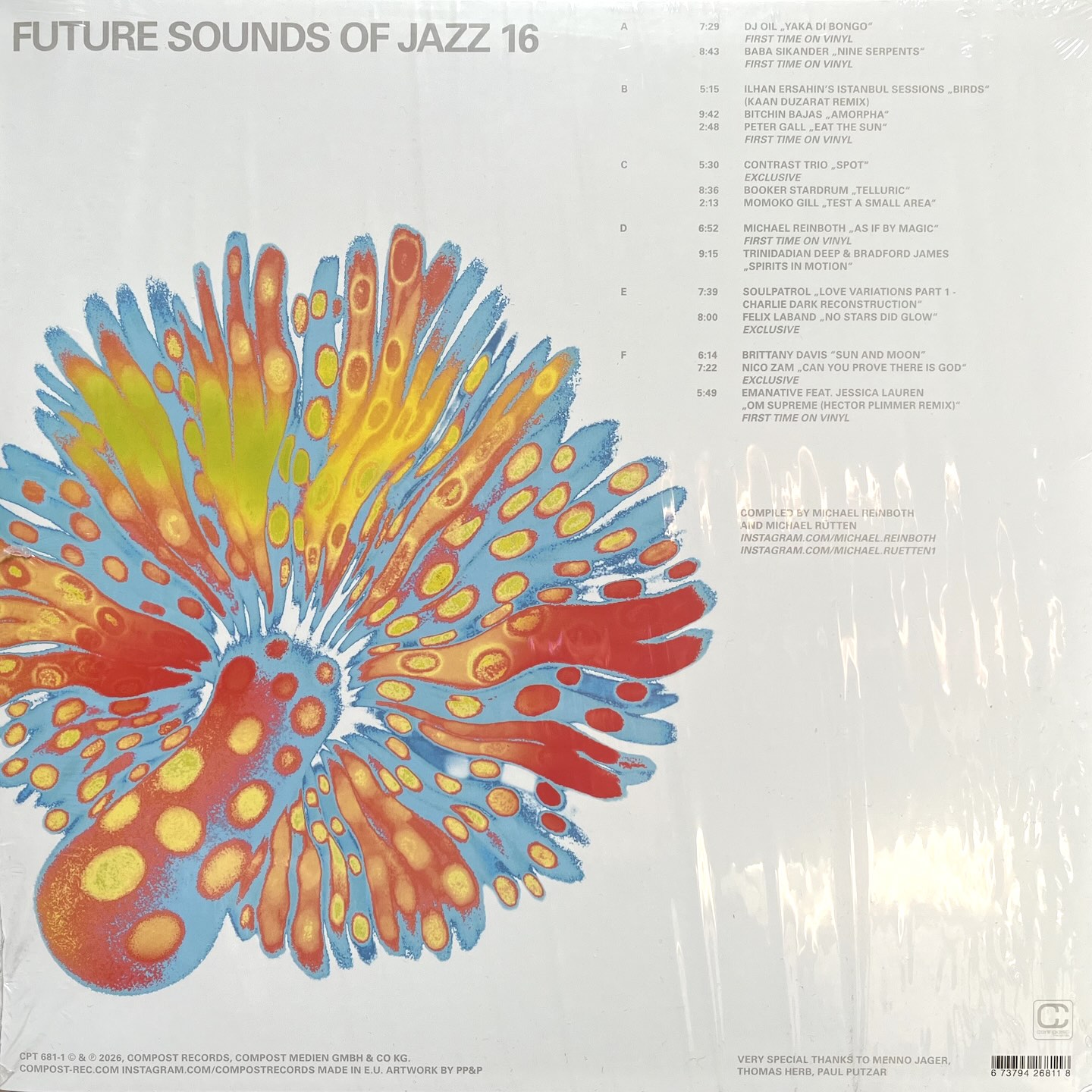
This is precisely what Future Sounds of Jazz has always represented to me, and why receiving Vol. 16, released by Compost Records in September 2026, felt like meeting an old friend who still has plenty of interesting stories to tell. Curated by Michael Reinboth and Michael Rütten, the compilation continues a conversation that began more than thirty years ago, although I don't think either of them is particularly interested in looking backwards. What strikes me about this new volume is how naturally it embraces the different interpretations of contemporary jazz and electronic music without becoming obsessed with defining either of them. There is room for experimentation, spiritual influences, intricate rhythmic constructions, more introspective passages and those wonderfully ambiguous moments when one musical language gradually dissolves into another. It is a selection that demands curiosity, and that is exactly what I expect from a series with this kind of history. The music moves through different atmospheres without feeling obliged to establish a comfortable continuity between every track. Emanative's Om Supreme, in Hector Plimmer's interpretation, offers one possible entrance into this world, while Bitchin Bajas' Amorpha suggests a different, more abstract direction. Brittany Davis' Sun And Moon brings another sensibility into the picture, and Ilhan Ersahin's Istanbul Sessions, revisited by Kaan Duzarat on Birds, adds a further perspective on the relationship between instrumental expression and electronic production. Michael Reinboth's own As If By Magic, Charles Petersohn's Zu Zu Music, featuring Mickey Neher, AdaSoul and Narjara Thamiz, and Beanfield's Catalpa contribute to a collection whose identity emerges progressively rather than announcing itself through a single sound. I like the fact that some tracks seem to belong to entirely different conversations. They make you reconsider the context of what you have just heard, which is often where the most interesting discoveries begin. A compilation doesn't have to please me from beginning to end in exactly the same way. On the contrary, I rather enjoy being challenged by a selection that occasionally takes me somewhere unexpected.
There is, however, another reason why this particular release has already become part of my personal musical history, and it actually precedes the arrival of the physical record. Some time ago, when the advance promotional material first reached me, I happened to be working on the sound curation of an art exhibition here in Milan, the city where I live and where I regularly develop musical environments for exhibitions, installations and other artistic events. I remember going through the tracks and almost immediately finding myself transported into a very particular imaginary space. It is something that happens to me quite often when music genuinely captures my attention: before I have even finished listening, images, associations and possible environments begin to take shape in my head. I start imagining how certain sounds might interact with a room, with the architecture, with the artworks or simply with the movement of people through a space. In this case, the compilation provided precisely that kind of unexpected stimulus, and four tracks in particular ended up becoming part of the sonic environment I was constructing for the exhibition.
The songs were Felix Laband's No Stars Did Glow, Nico Zam's Can You Prove There Is God, Baba Sikander's Nine Serpents and DJ Oil's Yaka Di Bongo. I had selected them almost instinctively, attracted by the different possibilities they seemed to offer, and only afterwards did I begin to understand how they could interact within the wider context of the exhibition. When I work on the sound of an artistic space, I am not simply looking for music that accompanies the visual material. I am interested in how sound can influence the perception of an environment, how it can suggest a mood without imposing one, how it can establish an almost invisible relationship between the artworks and the people experiencing them. Sometimes a particular rhythm can change the way a room feels; at other times, a more suspended or elusive passage can give an image an entirely different emotional weight. It is a delicate process, and one that I find endlessly fascinating, because the music is no longer experienced in isolation. It becomes part of something else, something that exists in a particular place and for a particular moment.
What happened with those four tracks was especially interesting because the original musical selection had already been made by someone else, with an entirely different purpose in mind. Reinboth and Rütten had brought these tracks together as part of their own vision, and months later I found myself using that same material to develop another experience, within another artistic context. I suppose this is one of the most beautiful consequences of sharing music: you never really know where it will end up, or what someone else might decide to create with it. A record can leave a studio, travel through a promotional network, reach somebody sitting in Milan and eventually become part of the atmosphere surrounding an exhibition. There is something rather poetic about that journey, especially when you consider that the entire process began with a compilation, a format that some people still insist on treating as a secondary product.
Music selected with a vision has the extraordinary ability to inspire new visions.
And then there is the physical record itself, which brings me to another rather personal consideration. This time, strangely enough, I didn't have to buy it. After discovering the music through the promotional material, I had the pleasure of receiving a physical copy courtesy of Compost Records, and I couldn't help smiling at the thought. I don't know whether this is the natural consequence of having dedicated so much of my life to researching and sharing music, or perhaps some peculiar form of musical karma finally deciding to return the favour. The truth is that I have spent such an extraordinary amount of money on records over the years that I occasionally prefer not to think about it. Like many collectors, I have accumulated an impressive number of objects that, from a purely practical point of view, I probably don't need. There are moments when I look around and almost feel embarrassed by the sheer quantity of music I own. And yet, every time I pick up an old record, open a CD booklet or rediscover a sleeve that I haven't seen in years, I immediately remember why I started doing all this. I am not particularly interested in romanticising the past or arguing that everything was better before the digital revolution. That would be rather unfair, especially considering how much technology has contributed to the discovery and circulation of music. I use digital tools constantly, and I appreciate the extraordinary possibilities they offer. But I still believe that a physical release establishes a relationship with the listener that goes beyond the actual sound. Vinyl, CDs, cassettes, whatever the format, all carry something of the work and intention behind them. There is the artwork, the typography, the credits, the choice of materials, the simple pleasure of holding an object that somebody has taken the time to produce. These things matter to me. A physical record occupies a place in your home and, eventually, in your personal history. You might forget about it for ten years, only to find it again one afternoon and suddenly remember the record shop where you bought it, the people you were spending time with or the particular period of your life when you first listened to it. I find that kind of connection quite extraordinary, and I don't think it can be reduced to nostalgia.
A record gives memory a shape.
Perhaps this is also why I have always felt that the work of a record label extends well beyond releasing music. There is a cultural responsibility involved in choosing what deserves to be presented, in deciding how it should be communicated and in creating a context that allows it to acquire meaning over time. Compost Records has been doing this for decades, and Future Sounds of Jazz remains one of the clearest examples of that approach. The series has never been particularly concerned with preserving jazz as a fixed set of musical conventions. Quite the opposite, in fact. It has consistently explored the possibilities of a word that, to my ears, has always suggested curiosity, experimentation and a certain freedom of thought. This is also the territory I have tried to explore through Apparel Music and its own interpretation of Jazzy, where jazz is understood less as a genre to reproduce than as an attitude capable of connecting different musical worlds. Looking at Future Sounds of Jazz Vol. 16 today, and thinking about my own The Future Sound Of Jazzy, I recognise a connection that feels much deeper than the obvious similarity between the two titles. It is the recognition of an influence that has accompanied my work for years, sometimes without me even being conscious of it. Writing about this album also marks a small but meaningful change for me personally. Although I have spent a considerable part of my life selecting, releasing, promoting and discussing music, this is the first time I have decided to write an Apparel Review under my own name. I have been thinking for some time about approaching this section from a slightly different perspective, bringing into it more of my own experiences, memories and reflections on the records that continue to cross my path. Thanks also to a new collaboration with Will at Only Good Stuff Promotion, whom I would like to thank for his generosity and enthusiasm, I will have the opportunity to receive more physical releases and dedicate some proper attention to them. I don't particularly want these articles to become conventional reviews in which a record is described, evaluated and eventually reduced to a handful of adjectives. I would much rather use them as an opportunity to talk about music and everything that surrounds it: the people, the objects, the artwork, the history, the peculiarities of this industry and, occasionally, the personal memories that a particular release manages to awaken.
I suppose that after so many years of living with music, running a label and continuing to collect records with more enthusiasm than common sense, I have accumulated a few things worth sharing. And I rather like the idea of doing so through the records themselves, allowing each release to lead the conversation wherever it wants to go. In this respect, Future Sounds of Jazz Vol. 16 couldn't have been a more appropriate starting point. It connects my early experiences as a collector with my present work, it reminds me of the importance of musical selection, and it has already contributed to an artistic project that took place here in Milan. Most importantly, it has given me a reason to think once again about why I continue to be so attached to this extraordinary, occasionally absurd world of records.
So my thanks go to Compost Records, to Michael Reinboth and Michael Rütten, to the artists involved and to everyone who still believes that selecting and presenting music can be a creative act in its own right. More than thirty years after the first volume, this series continues to justify the space it occupies on my shelves, and I am rather pleased that another chapter has now joined the collection. Somewhere among all those CDs, there is still that first Future Sounds of Jazz compilation I bought many years ago. I imagine I will take it out again soon, perhaps listen to it from beginning to end and discover that, once more, it has something new to tell me.
Perhaps the future of jazz was never really a sound. It was the freedom to keep searching for it.
Release date 18th of September 2026


