APPAREL INTERVIEW:

Marco Fantini
Artist [Italy]


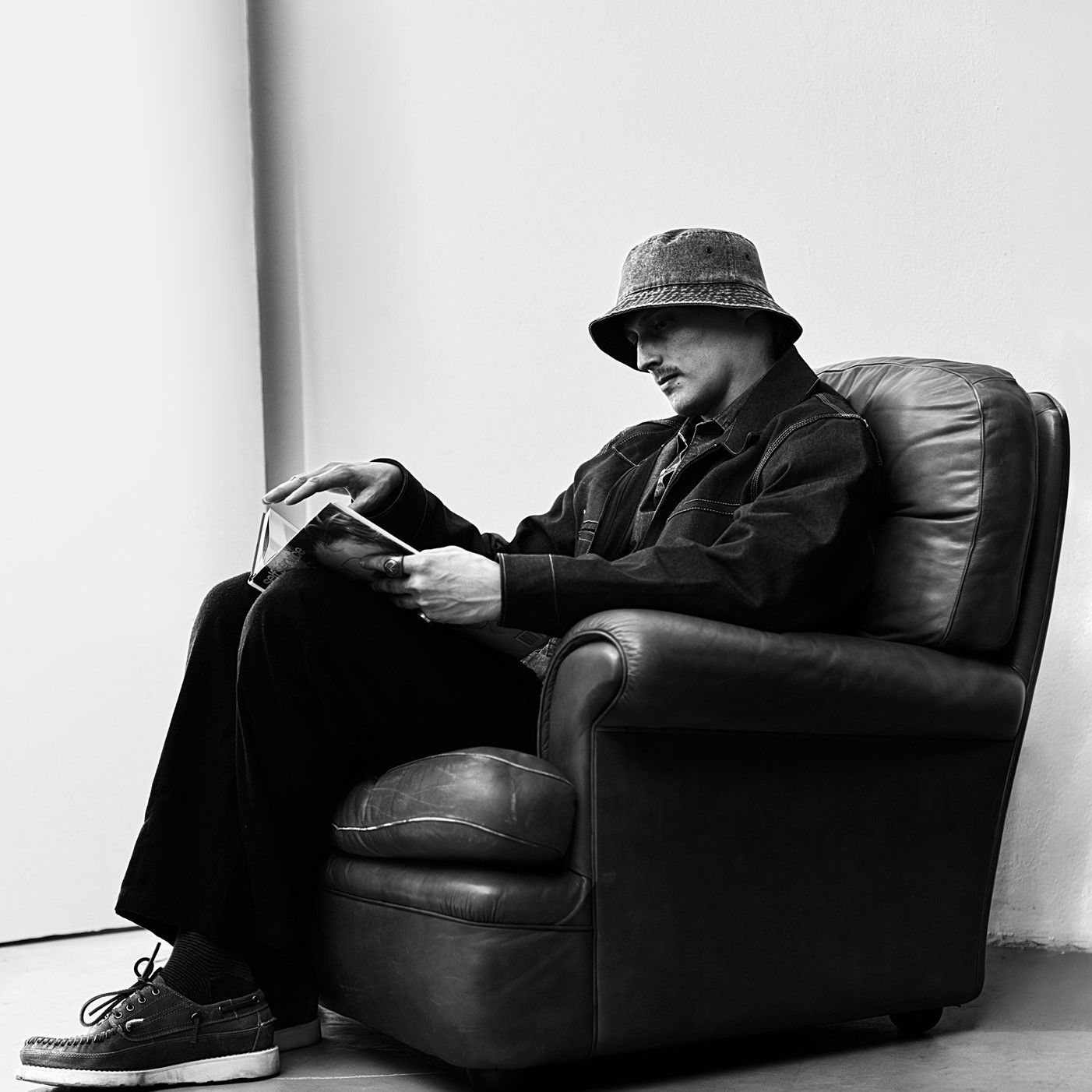
There are interviews built around a list of questions, and then there are conversations that simply happen. Marco Fantini welcomed us into his home in Milan, in what used to be a billiard room and is now an apartment filled with artworks, design furniture, walls completely covered with paintings of every size, a kitchen where he recently installed a water purifier he is particularly proud of, and his studio next to the kitchen, where, however, he no longer feels entirely at ease. Marco’s home is a carefully defined space, built over three years, where every object — at least to us — seems to have found its place and become part of an evolving story. During the conversation, his kitten Zelda kept circling around us, keeping us company, moving in and out between the courtyard and the living room as if checking that everything was alright, that we were taking good care of her human. The interview immediately turned into a conversation, full of philosophical detours, cigarette smoke and thoughts chasing one another. The kind of exchange that makes you constantly want to ask a question, but before you can hold on to one, another thought has already taken its place, and you realise it’s better to let things flow and just go with it. Marco is someone who casually drops little gems while talking. Insights, references, and it’s up to you to notice them and pick them up. Some you catch right away, others come back to you days later. What you are about to read is, in fact, a flow of thoughts touching on art, the person, obsessions, mistakes, taste, time, and ways of being in the world. There is no real structure, but maybe that’s exactly the point. So instead of starting with a question, this time we begin in medias res, in the middle of a conversation that had already begun.


APPAREL INTERVIEW:

Marco Fantini
Artist [Italy]


There are interviews built around a list of questions, and then there are conversations that simply happen. Marco Fantini welcomed us into his home in Milan, in what used to be a billiard room and is now an apartment filled with artworks, design furniture, walls completely covered with paintings of every size, a kitchen where he recently installed a water purifier he is particularly proud of, and his studio next to the kitchen, where, however, he no longer feels entirely at ease. Marco’s home is a carefully defined space, built over three years, where every object — at least to us — seems to have found its place and become part of an evolving story. During the conversation, his kitten Zelda kept circling around us, keeping us company, moving in and out between the courtyard and the living room as if checking that everything was alright, that we were taking good care of her human. The interview immediately turned into a conversation, full of philosophical detours, cigarette smoke and thoughts chasing one another. The kind of exchange that makes you constantly want to ask a question, but before you can hold on to one, another thought has already taken its place, and you realise it’s better to let things flow and just go with it. Marco is someone who casually drops little gems while talking. Insights, references, and it’s up to you to notice them and pick them up. Some you catch right away, others come back to you days later. What you are about to read is, in fact, a flow of thoughts touching on art, the person, obsessions, mistakes, taste, time, and ways of being in the world. There is no real structure, but maybe that’s exactly the point. So instead of starting with a question, this time we begin in medias res, in the middle of a conversation that had already begun.


MARCO FANTINI by TU copia


Marco Fantini Q&A


- […] It’s absurd that I would have the presumption to think that my way of acting should involve the disappearance of my work as a form of participation in the great debate within the art world. I tend to face the present the same way I have always approached my way of making art, which is — how can I put it — witnessing the miracle of things appearing, rather than imposing the will to create them. Sometimes I like to say that my paintings are leftovers, residues. The impulse has always been not to act, not to do. I even built some amusing theories around this, I don’t know whether they are just verbal pretexts or actual truths, but I sometimes like to say that, from an entropic point of view, it is impossible to produce nothing. Even if, according to the laws of physics, I were forced to produce nothing, if I worked with the intention of producing nothing, it would still be impossible not to produce something, precisely because of an empirical law related to entropy. And so my works are generally the by-products of work that has not completely transformed itself into absence. But they are born from the idea of absence. In the end, my whole life is based on this. I have understood these things only recently, while writing, but we will have time to talk about that.


-So is your art about being or appearing?

- I need to think about that, because to speak about being and appearing means opening an abyss. One would first have to reflect on the relationship between being and appearing. What is the difference between the two? The ambiguity of the question lies in the fact that they are not true opposites; the real opposition is perhaps between being and seeming. Because everything that is not, merely seems — it does not appear. That is what I would be inclined to say. If you ask me whether I would prefer my work to be or to seem, I believe I would prefer it to be. The truth is that what appears in my work is everything that belongs to the original intention with which I began to act. When that intention disappears, what remains is the essential core that interests me, something I probably would not even be able to explain properly, because I do not know how it came into being. I only know that I recognised it. When it appeared, I recognised it.


-Sometimes you only understand what really happened at the end of the journey.

- One could say that the end of a journey opens an even more terrible enigma, one without an answer. If I were to ask you whether you would rather be or appear, appearing, after all, is also somehow tied to being. What is not cannot be, but what is seen cannot not be, or can it? When I see a work of art, do I know it is art because someone told me so, or because it has been placed in a space that is designated for works of art? It is not certain that, if I found it leaning against a wall somewhere, I would think of it as a work of art. I would have to do as Duchamp did and say: this is a work of art simply because I say it is. So perhaps something does not exist until you name it. Take the word soul, so widely used today: we do not know exactly how to describe what it is, we do not even know whether it exists, and yet we use the word and grant it a form of existence precisely because it describes something we are unable to define. We invented a word in order to give a formal nucleus to something that perhaps does not exist. The soul, until proven otherwise, both exists and does not exist. There is no objective proof of its existence. So there are many reflections one could make about being and appearing. I am not even entirely sure of our own existence...


-And within this tension between being, appearing, and seeming… you, at this moment, as an entity apparently present here, how are you?

- At the moment, I have found a certain balance. Today, in order to appear in the world, one needs filters: museums, for instance, or social media. An artist cannot remain confined to himself: works begin to live when they are recognised by other people. Appearance therefore becomes necessary, because you want your “children” to encounter other gazes besides your own.


-Let’s think about ownership, and the relationship between the work, its creator, and the one who experiences it…

- Think of someone who says, “don’t touch my book.” You didn’t write it, yet you feel it is yours, and that is something beautiful. In contemporary culture, this sense of possession has flattened out, because everything belongs to everyone; attachment develops less toward the thing itself and more toward what it represents. For instance, being an art collector is often symbolic of a certain mythology built around that figure. In this case, appropriation tends to serve more as a reinforcement of one’s social image than as a genuine bond with the works themselves. Take certain artworks: if someone buys a Banksy, I don’t believe they can truly grow attached to it. I know I sound somewhat reactionary when I say this, but the truth is that a work of art contains secrets. They are not always easily translatable, yet through a sustained relationship with the work you develop a kind of complicity with those mysteries, and from time to time they open up new possibilities. Over the years, you begin to see the work change; when you “live” with an artwork long enough, you witness its transformation, because it changes with you. This kind of mutation can only occur if the work is alive. There is no fixed meaning that remains eternally identical to itself — there is, instead, a living organism. This is where my passion for Picasso comes from, and for the vital force present in all of his works. Everything he produced carries this imprint, some more intensely, others less so, but fundamentally, I do not want to possess an object; I want to possess a soul. And here we return to what we were saying earlier: soul — a word that ultimately means everything and nothing, much like the word God. And yet we know what these words are pointing toward. Of course, for you God may be one thing, for someone else something entirely different. A concept, however compelling, is born already dead, because it belongs to philosophy. Philosophers create concepts, while the artist, I think, is neither trained nor equipped to conceive them in the same way. For this reason, I tend to trust instinct more. No matter how intelligent an artist may be, he/she will never be Jacques Derrida or Friedrich Nietzsche. Today, the artist is a bit of everything: part philosopher, part scientist, part poet, part madman, part shaman. A composite being, stretched across multiple dimensions. Take me: recently, I wrote a book and noticed that the things that interest me begin to turn into subjects. Take fear, for example, which I mention in the text: at a certain point, I let it speak. It declares itself, how can I put it, incapable of adapting to certain conditions, becoming a speaking subject. So everything that turns into language, for me, acquires its own voice.


-Do you think you discovered something new through writing? Sometimes the act of writing itself, which by nature has a beginning and an end, helps clarify thoughts that are otherwise more chaotic, because they are trapped in the mind.

- I have always written a little, though never with the intention of writing a book, but I have always done it, since I was a child. I was drawn to a kind of automatic writing, you could say. Certainly, writing in these past years has generated something completely different in me. The dedication with which you not only observe the work you are doing, but observe your entire existence, changes. This constant inner work has produced a new level of awareness of my relationship with art. Understanding it is somewhat traumatic. As long as I feel that I am still inside the book, still inside the work I am creating, it is as if the work is still a prisoner of many of my idealisations or narcissisms. As long as you continue to recognise yourself in the work, the work is not finished. The work is finished the moment you begin to ask yourself what it is that you have done. It is strange, because even though you no longer fully recognise yourself, you are surprised: “How did I make this? How did this sentence come to me?” The moment you realise that you are developing thoughts and images that are unfamiliar even to yourself, that is when the work begins to have a life of its own, and you can free yourself from it. Even today, I still question my paintings. When I look at the painting at the entrance here, I still ask myself questions: Why is he holding a pencil? Why is he a child? Why did I paint the letter P? These are questions I ask myself with a certain narcissistic pleasure, because I like those things, they represent me. Then there comes a moment when they no longer represent me: the mirror no longer reflects the image I have of myself, but shows me another person, the external observer.


-Do you remember the first time you painted something?

- The first work I can truly consider as such was a collage I made on a desk my father had given me, because he wanted me to start putting together a small architect’s studio. He gave me this desk that I didn’t like, and I said, “Why don’t I make a collage on top of it?” I remember that the moment I began working on it, I also began asking myself questions: Why did I place a chair? What relationship is there between the chair and this figure? How can I connect them? So my first creative experience was actually decorative. Later, when I painted my first oil painting, I was under the effects of hallucinogenic mushrooms, and honestly I cannot say to what extent they helped me from a creative point of view. But I do remember the first time I identified, within my own path, a kind of stylistic signature that would then follow me in all my later works. I had painted figures that looked almost like pieces of flesh. At a certain point, since I couldn’t resolve the background, I took some gesso and said, “Now I’ll erase everything and try to work on the background instead.” Using the gesso with a spatula, in a split second I realised how beautiful it was that those pieces of flesh were suspended in nothingness, without backgrounds, landscapes, or supporting figures. They were extraordinary. To arrive at any real creative awareness I went through a thousand attempts, influenced by the work of others. But I still remember that founding gesture, which has repeated itself even in more recent years. 


-And did finding a stylistic signature reassure you?

It did not reassure me, it surprised me. The painting I’m talking about, the one that triggered this awareness in me, I believe is one of the most beautiful paintings I have ever made. It is completely white. I also described it in the book to explain certain mechanisms that happen to me. I have never been able to recreate it. After all, I had started it almost as a joke. I took some filler, spread it over the surface, and then applied enamel paint. That white was beautiful because it had been compromised from the very beginning by mistakes and expired materials. If I had tried to repeat it, it would not have been possible.


-But through all of this, Marco, do you enjoy painting?

And here you touch on an important point. The truth is, I have never enjoyed painting. I never saw it as a relaxing exercise. What I have always loved is that sense of displeasure, that labor, that agonising anticipation through all the processes I employed. I am self-taught, so I’ve always tried to “provoke” the work in every possible way so that it would give me something to latch onto, something to continue from. But this exercise was intensely frustrating. I never had a subject to start from; I always began with white, that unbearable white. Now, try to put yourself in my shoes: one does this work, has to participate in fairs, exhibitions, deadlines are tight… and I never knew what the hell I was going to paint! I never developed a formula, unlike Lucio Fontana, who always made his “cut” the same way. What mattered to me was the theme of fear and surprise. It’s the only signature of my work that appeared from time to time. And I have always been frenetic. The truth is, that displeasure was something I loved, because every so often, when I broke through those barriers of discovery, I felt like a great artist — because I had resurrected something that seemed dead. When you work with complex layers of color, saturating them, you can no longer pigment them properly, or you have piled too many materials on top, and you keep removing, removing… and nothing ever happens. It’s hard. Then, there comes a critical point when it feels like you should take it all and throw it away. And when you reach that point and discover a possibility, a breakthrough, the joy is so immense that it compensates for all the previous frustrations. But I want to tell you why the thought you triggered with your question is so painful and important: because I can attribute my creative impasse to a variety of factors, a particular incident, a problem with an art dealer, a disappointment, a moment of depression, whatever you like… The truth is, I found painting unbearable. It had become a displeasure I no longer liked, a disgust. Now I am returning to the “beautiful displeasure,” so to speak. The book (which I am finishing) helped me. For two years I turned my back on painting, because I was writing at a desk placed so that my paintings were behind me. I attempted a return to painting from the blind side of the mirror, the part that no longer reflects anything, because I could no longer bear it. I began to recognise myself, to recognise the trauma within my work. I started giving it meaning — something I usually abhor — leaving aside even the drama itself. It was precisely the idea of attributing meaning to my work that caused me displeasure, that made me feel this disgust. When you feel disgust, you simply cannot continue.


-I think we’ve reached the point where we really have to talk about the book...

- So, one day I was talking to someone who knew a lot about art and life, who said to me: why don’t you write a book about art? Since I wasn’t painting at the time, I thought: why not? From that moment it took me three months just to get into the mindset of writing it, because I couldn’t understand what “voice” I should give it. I had impostor syndrome, so I felt I had to sound like a writer. In the first phase I tried to use the difficult words of academic essays, to sound intelligent. I was scattering refined words all over the pages, until I came across a photograph my mother had taken of me at the entrance of our house, dressed as a painter. There was a blank canvas, and I was holding a brush. So I began writing the description of that photograph, of that memory, without even knowing where I would end up, but from there I actually determined the form of the book, and also all the connections that later allowed me to anchor myself to other concepts I wanted to talk about. I don’t know whether I talk about time, about what remains, or about the tragic — maybe that’s not even the point. In truth, the pivot of everything is a photograph. In that photograph there is a painting on an easel: a horse galloping. But I hadn’t painted it. It was a lithograph printed on canvas, the kind children are supposed to color. And yet the whole scene, the entrance of the house, the pose, the construction of the image, suggested that I was the author. I also remember a conversation between my mother and a neighbour in which my mother said that I had painted that horse. I knew perfectly well that I hadn’t painted it. And yet, at a certain point, a kind of silent agreement was formed: I accepted that version. Until I convinced myself that, in some way, I must have really painted it, because that was what my mother wanted for me. I couldn’t disappoint that expectation. My mother had an idea of me, an ideal version that included art. Perhaps my becoming an artist began there too — from that projection, from that constructed image, somehow imposed, which I eventually ended up inhabiting. It is as if we had been accomplices together in a small imposture: that of the “gifted” child, the one naturally inclined toward art, while in reality maybe he would have preferred to do something else, like ride motocross bikes, for example! In a way, the artist was more her than me: she built the scene, took the photograph, organised the narrative. I simply stepped inside that image. All my life I have tried to prove that I was not an impostor, that I was truly an artist. The truth is that I was an impostor, I have been one. But all my research, in the end, has also been this: proving, to myself before anyone else, that I am not. In any case, I wrote the book over two years. Out of more than three hundred pages I kept about two hundred. Now I might need to add something more because it is very condensed. It’s not easy to say what this book is. It’s not a novel, not an essay, not a biography, not poetry, not simply artist writings; it’s a bit all of these things together and none of them. In fact, it’s hard to understand where to place it. It has two titles: Rebus and Immaterial Biography, which is also the title of one of my artworks. The second is perhaps more analytical, it sounds deeper, but Rebus is the one that fits the whole story better. Because the text is scattered with elements that function like clues, a bit like a photograph full of discordant elements that nonetheless speak to each other and make the image readable. So Rebus is also a way of telling the reader: be aware that what you are reading is a riddle, so don’t expect clear answers. In fact, the book is full of questions to which I give no answers. There are moments when I read it and it seems perfectly clear, and the next day I read it again and it is no longer so clear. It is as if the meaning were not fixed, but moving.


-Now a question that calls for a slightly more instinctive approach.

- Sorry, I’m not exactly someone who approaches conversation in an instinctive way to begin with…


-Of course. We’re curious to know what your ideal day would be, from the moment you wake up to the moment you go to bed.

- Well, since I’ve never really had them, I’m very fond of appointments. I don’t keep an agenda and, since I started working, I’ve never really had proper appointments, so when I do have one — a work appointment, for example — I enjoy it a lot. I would love to have a diary full of work appointments. The day becomes even better when, among those appointments, I can cancel a few… And then it becomes wonderful when evening arrives, also because I actually work more at night than during the day. In my opinion, if you reach the evening and you’re still full of energy, it means the day has been productive. A day is good when you still feel like doing something. For me, the perfect day is when I don’t feel like watching a film, when I don’t feel the need to switch my brain off. At most, you watch something on YouTube, a concert maybe, but just like that, without really needing distraction. When you feel you don’t need diversions, it means the day has been full. So yes, a day full of appointments, even appointments you might end up missing, but the real satisfaction is being wanted, feeling necessary to someone or to something. Because the life of artists, after all, is also crossed by a sense of uselessness: art, in the end, is useless. Another thing that makes a day beautiful — and this is very simple — is when I manage to help a young artist, someone who has talent. I’ve always had this desire to help younger people, to find a key for someone who needs one. Artists are often closed within their own need for success, but they don’t really help others. I’ve always admired those who help people in a concrete way. So a perfect day is when I’ve worked, when I’ve felt useful, when I’ve helped someone, and when I reach the evening and still have energy.


-Having appointments just to cancel them, that’s quite something. In this lack of structure in your day, do you ever feel lost?

- Getting lost is a strange thing, because the boundaries are always very thin. It’s like the relationship between the sadist and the masochist: in reality, the sadist does what the masochist asks of him. The masochist says no, but within that refusal he finds his form of pleasure, so in the end the roles blur. The boundaries are always unstable. Something similar happens with getting lost: there is the moment in which you aspire to be lost, and the moment in which you find yourself again. The moment of loss is often a decisive one. Very often, the moment you feel lost is the moment in which, in some way, you have chosen to lose yourself. In everyday life, we tend to avoid these moments. Many people devote their lives entirely to the pursuit of recognition. But when I think of certain figures — Jung, for instance — I don’t believe he spent his life seeking recognition. There are people who live in a kind of self-sustaining world, closed within it, and precisely because they are closed off, they are able to understand what they truly want. The moment of getting lost is the moment in which you accept your nature, and also the possibility of failure, something you previously could not even allow yourself to conceive. Falling is often a moment in which something violates your deepest nature, yet at the same time it is a decisive moment. The fall can be liberating; it can be an opportunity. There is a story told by a rabbi, who was also a psychoanalyst, about lobsters. A lobster grows, but its shell does not grow with it, so at a certain point it must hide, shed its shell, and wait for a new one to form. It repeats this process many times throughout its life. In essence, the lobster grows through a painful condition, because it is pain that forces it to change its shell. The idea is that we often grow precisely through pain: pain becomes an opportunity for growth and transformation.


-If you could be reborn as someone else, who would you choose?

- I’d be torn between Marvin Gaye and Paul Newman. Paul Newman was important to me because he was the kind of character to whom everything always went wrong. Beyond the fact that many considered him the most handsome man in the world, as a child I was fascinated by him because he was a loser. I’ve always been fascinated by the role of the anti-hero, the losing hero.


-And if you were a city, which one would you be?

- I haven’t seen them all, but the one I feel most connected to — in terms of memories, emotions — is Mexico City.


-If you were an object?

- If I were an object, I’d be a knife.


-If you were a geometric shape?

- I’d be an impossible prism, the kind I often make. You’ve seen my impossible prisms, right?


-The most beautiful museum you’ve ever visited?

- The Fondation Beyeler in Basel. But also the National Museum of Anthropology in Mexico City, with all its pre-Columbian collections, it’s incredible.


-Solitude or company?

- Company. I’m a social animal, always have been. The truth is, I spend a lot of time alone, especially lately. These days I only go out when someone calls me.


-Smoking or alcohol?

- Both, but more smoking. I’ve been smoking three packs a day since I was 25. I started late, but very quickly worked my way up to three packs…


-You can have only one artwork in your living room. Which one do you choose?

- If I had to choose, I would go for a Picasso from the 1950s, so from his later period, connected to that group of works he himself was willing to sell. I think there’s something very powerful in those pieces, also tied to influences from African culture and to almost ritualistic mechanisms. Otherwise, I would choose one of the studies for Les Demoiselles d’Avignon — not the finished work, but one of the many preparatory studies, even large ones, which are rarely seen. Some collectors, like Ernst Beyeler, managed to acquire them, even though Picasso didn’t want to sell them. He was probably the greatest collector of his own work and fully aware of the difference in value between those pieces and the others. For example, Guernica, when seen in Madrid, doesn’t always strike you as much as one might expect. But the preparatory studies, especially the quickly executed oil sketches, are incredible! For me, that’s the point: Picasso is at his best when the painting still feels like a note, a sketchbook page, a draft, rather than a finished work.


-A recurring dream?

- I have two recurring dreams, one bad and one good. The bad one is that at night, while I’m sleeping, I’m convinced I have nails in my mouth. I feel an intense anguish because I think I might swallow them and die. So I wake up and, if I’m in time, I run to the bathroom to spit them out; if instead I already feel like I’ve almost swallowed them, I start spitting on the floor wherever I am. Then I fully wake up with the very clear sensation that I wasn’t just dreaming, but that I actually had something harmful in my mouth. The good dream, on the other hand, is the one in which I discover how to fly. The mechanism is this: in order to fly, you have to let yourself fall and, until the very last moment, not be afraid of hitting the ground. If even for a second you are afraid, you crash; but if you are not afraid until the very end, then you remain suspended. So I would let myself fall and remain a few centimetres above the ground, moving around. They weren’t big flights, but I was flying. In the dream I would run home to tell my mother about the discovery and, when I walked in, I would find her in the living room suspended about three metres above the floor while cleaning the windows, with a cloth, detergent, and a ladder. She would look at me and say, “Now I’ve discovered what our secret is.” I haven’t had this dream in a while, but for many years it came back often. A bit like dreams in general: it seems to me that with time they decrease, but every now and then they return.


-Is there a question that you have never been asked but would like someone to ask you?

- My expectation would be that one day someone would ask me the same questions I ask myself while I work. In the book I also wrote a sort of anecdote, halfway between true and false, but in the book it is never clear what is true and what isn’t. There is this figure of an interviewer who doesn’t actually ask questions, but makes statements disguised as questions, starting from prejudices about what I do. Something like: “Don’t you think there is already enough pain in the world? Why paint more pain?” That is not a question, it’s a statement: you are saying that I paint painful things that bother you. The real questions I ask myself while working, however, I don’t remember them, and the question I am waiting for is a bit like what appears in a painting: something you did not expect. So it’s impossible that someone will ask me those questions, because I don’t even know them myself. I like it when someone reads my mind, when an understanding is created without competition. It happened once with a man in a bar: we started talking and there was no competition, but a kind of synergy. What he said connected to what I said and vice versa, and the conversation grew on its own. That’s what I like, more than interviews themselves… I like these moments of complicity that sometimes emerge during them. I think an interview is an opportunity to arrive at art without starting from art, or to start from art and arrive at something that seems to have nothing to do with art. Because you don’t make art with art: art is made with everything that passes through us. That’s why the best interviews are the ones that at a certain point go somewhere else. An artist shouldn’t only talk about art.


-…And today, did you feel even just a hint of that understanding you’re talking about?

- I think so, yes.


-Do you remember the first time you painted something?

- The first work I can truly consider as such was a collage I made on a desk my father had given me, because he wanted me to start putting together a small architect’s studio. He gave me this desk that I didn’t like, and I said, “Why don’t I make a collage on top of it?” I remember that the moment I began working on it, I also began asking myself questions: Why did I place a chair? What relationship is there between the chair and this figure? How can I connect them? So my first creative experience was actually decorative. Later, when I painted my first oil painting, I was under the effects of hallucinogenic mushrooms, and honestly I cannot say to what extent they helped me from a creative point of view. But I do remember the first time I identified, within my own path, a kind of stylistic signature that would then follow me in all my later works. I had painted figures that looked almost like pieces of flesh. At a certain point, since I couldn’t resolve the background, I took some gesso and said, “Now I’ll erase everything and try to work on the background instead.” Using the gesso with a spatula, in a split second I realised how beautiful it was that those pieces of flesh were suspended in nothingness, without backgrounds, landscapes, or supporting figures. They were extraordinary. To arrive at any real creative awareness I went through a thousand attempts, influenced by the work of others. But I still remember that founding gesture, which has repeated itself even in more recent years. 


-And did finding a stylistic signature reassure you?

It did not reassure me, it surprised me. The painting I’m talking about, the one that triggered this awareness in me, I believe is one of the most beautiful paintings I have ever made. It is completely white. I also described it in the book to explain certain mechanisms that happen to me. I have never been able to recreate it. After all, I had started it almost as a joke. I took some filler, spread it over the surface, and then applied enamel paint. That white was beautiful because it had been compromised from the very beginning by mistakes and expired materials. If I had tried to repeat it, it would not have been possible.


-But through all of this, Marco, do you enjoy painting?

And here you touch on an important point. The truth is, I have never enjoyed painting. I never saw it as a relaxing exercise. What I have always loved is that sense of displeasure, that labor, that agonising anticipation through all the processes I employed. I am self-taught, so I’ve always tried to “provoke” the work in every possible way so that it would give me something to latch onto, something to continue from. But this exercise was intensely frustrating. I never had a subject to start from; I always began with white, that unbearable white. Now, try to put yourself in my shoes: one does this work, has to participate in fairs, exhibitions, deadlines are tight… and I never knew what the hell I was going to paint! I never developed a formula, unlike Lucio Fontana, who always made his “cut” the same way. What mattered to me was the theme of fear and surprise. It’s the only signature of my work that appeared from time to time. And I have always been frenetic. The truth is, that displeasure was something I loved, because every so often, when I broke through those barriers of discovery, I felt like a great artist — because I had resurrected something that seemed dead. When you work with complex layers of color, saturating them, you can no longer pigment them properly, or you have piled too many materials on top, and you keep removing, removing… and nothing ever happens. It’s hard. Then, there comes a critical point when it feels like you should take it all and throw it away. And when you reach that point and discover a possibility, a breakthrough, the joy is so immense that it compensates for all the previous frustrations. But I want to tell you why the thought you triggered with your question is so painful and important: because I can attribute my creative impasse to a variety of factors, a particular incident, a problem with an art dealer, a disappointment, a moment of depression, whatever you like… The truth is, I found painting unbearable. It had become a displeasure I no longer liked, a disgust. Now I am returning to the “beautiful displeasure,” so to speak. The book (which I am finishing) helped me. For two years I turned my back on painting, because I was writing at a desk placed so that my paintings were behind me. I attempted a return to painting from the blind side of the mirror, the part that no longer reflects anything, because I could no longer bear it. I began to recognise myself, to recognise the trauma within my work. I started giving it meaning — something I usually abhor — leaving aside even the drama itself. It was precisely the idea of attributing meaning to my work that caused me displeasure, that made me feel this disgust. When you feel disgust, you simply cannot continue.


-I think we’ve reached the point where we really have to talk about the book...

- So, one day I was talking to someone who knew a lot about art and life, who said to me: why don’t you write a book about art? Since I wasn’t painting at the time, I thought: why not? From that moment it took me three months just to get into the mindset of writing it, because I couldn’t understand what “voice” I should give it. I had impostor syndrome, so I felt I had to sound like a writer. In the first phase I tried to use the difficult words of academic essays, to sound intelligent. I was scattering refined words all over the pages, until I came across a photograph my mother had taken of me at the entrance of our house, dressed as a painter. There was a blank canvas, and I was holding a brush. So I began writing the description of that photograph, of that memory, without even knowing where I would end up, but from there I actually determined the form of the book, and also all the connections that later allowed me to anchor myself to other concepts I wanted to talk about. I don’t know whether I talk about time, about what remains, or about the tragic — maybe that’s not even the point. In truth, the pivot of everything is a photograph. In that photograph there is a painting on an easel: a horse galloping. But I hadn’t painted it. It was a lithograph printed on canvas, the kind children are supposed to color. And yet the whole scene, the entrance of the house, the pose, the construction of the image, suggested that I was the author. I also remember a conversation between my mother and a neighbour in which my mother said that I had painted that horse. I knew perfectly well that I hadn’t painted it. And yet, at a certain point, a kind of silent agreement was formed: I accepted that version. Until I convinced myself that, in some way, I must have really painted it, because that was what my mother wanted for me. I couldn’t disappoint that expectation. My mother had an idea of me, an ideal version that included art. Perhaps my becoming an artist began there too — from that projection, from that constructed image, somehow imposed, which I eventually ended up inhabiting. It is as if we had been accomplices together in a small imposture: that of the “gifted” child, the one naturally inclined toward art, while in reality maybe he would have preferred to do something else, like ride motocross bikes, for example! In a way, the artist was more her than me: she built the scene, took the photograph, organised the narrative. I simply stepped inside that image. All my life I have tried to prove that I was not an impostor, that I was truly an artist. The truth is that I was an impostor, I have been one. But all my research, in the end, has also been this: proving, to myself before anyone else, that I am not. In any case, I wrote the book over two years. Out of more than three hundred pages I kept about two hundred. Now I might need to add something more because it is very condensed. It’s not easy to say what this book is. It’s not a novel, not an essay, not a biography, not poetry, not simply artist writings; it’s a bit all of these things together and none of them. In fact, it’s hard to understand where to place it. It has two titles: Rebus and Immaterial Biography, which is also the title of one of my artworks. The second is perhaps more analytical, it sounds deeper, but Rebus is the one that fits the whole story better. Because the text is scattered with elements that function like clues, a bit like a photograph full of discordant elements that nonetheless speak to each other and make the image readable. So Rebus is also a way of telling the reader: be aware that what you are reading is a riddle, so don’t expect clear answers. In fact, the book is full of questions to which I give no answers. There are moments when I read it and it seems perfectly clear, and the next day I read it again and it is no longer so clear. It is as if the meaning were not fixed, but moving.


-Now a question that calls for a slightly more instinctive approach.

- Sorry, I’m not exactly someone who approaches conversation in an instinctive way to begin with…


-Of course. We’re curious to know what your ideal day would be, from the moment you wake up to the moment you go to bed.

- Well, since I’ve never really had them, I’m very fond of appointments. I don’t keep an agenda and, since I started working, I’ve never really had proper appointments, so when I do have one — a work appointment, for example — I enjoy it a lot. I would love to have a diary full of work appointments. The day becomes even better when, among those appointments, I can cancel a few… And then it becomes wonderful when evening arrives, also because I actually work more at night than during the day. In my opinion, if you reach the evening and you’re still full of energy, it means the day has been productive. A day is good when you still feel like doing something. For me, the perfect day is when I don’t feel like watching a film, when I don’t feel the need to switch my brain off. At most, you watch something on YouTube, a concert maybe, but just like that, without really needing distraction. When you feel you don’t need diversions, it means the day has been full. So yes, a day full of appointments, even appointments you might end up missing, but the real satisfaction is being wanted, feeling necessary to someone or to something. Because the life of artists, after all, is also crossed by a sense of uselessness: art, in the end, is useless. Another thing that makes a day beautiful — and this is very simple — is when I manage to help a young artist, someone who has talent. I’ve always had this desire to help younger people, to find a key for someone who needs one. Artists are often closed within their own need for success, but they don’t really help others. I’ve always admired those who help people in a concrete way. So a perfect day is when I’ve worked, when I’ve felt useful, when I’ve helped someone, and when I reach the evening and still have energy.


-Having appointments just to cancel them, that’s quite something. In this lack of structure in your day, do you ever feel lost?

- Getting lost is a strange thing, because the boundaries are always very thin. It’s like the relationship between the sadist and the masochist: in reality, the sadist does what the masochist asks of him. The masochist says no, but within that refusal he finds his form of pleasure, so in the end the roles blur. The boundaries are always unstable. Something similar happens with getting lost: there is the moment in which you aspire to be lost, and the moment in which you find yourself again. The moment of loss is often a decisive one. Very often, the moment you feel lost is the moment in which, in some way, you have chosen to lose yourself. In everyday life, we tend to avoid these moments. Many people devote their lives entirely to the pursuit of recognition. But when I think of certain figures — Jung, for instance — I don’t believe he spent his life seeking recognition. There are people who live in a kind of self-sustaining world, closed within it, and precisely because they are closed off, they are able to understand what they truly want. The moment of getting lost is the moment in which you accept your nature, and also the possibility of failure, something you previously could not even allow yourself to conceive. Falling is often a moment in which something violates your deepest nature, yet at the same time it is a decisive moment. The fall can be liberating; it can be an opportunity. There is a story told by a rabbi, who was also a psychoanalyst, about lobsters. A lobster grows, but its shell does not grow with it, so at a certain point it must hide, shed its shell, and wait for a new one to form. It repeats this process many times throughout its life. In essence, the lobster grows through a painful condition, because it is pain that forces it to change its shell. The idea is that we often grow precisely through pain: pain becomes an opportunity for growth and transformation.


-If you could be reborn as someone else, who would you choose?

- I’d be torn between Marvin Gaye and Paul Newman. Paul Newman was important to me because he was the kind of character to whom everything always went wrong. Beyond the fact that many considered him the most handsome man in the world, as a child I was fascinated by him because he was a loser. I’ve always been fascinated by the role of the anti-hero, the losing hero.


-And if you were a city, which one would you be?

- I haven’t seen them all, but the one I feel most connected to — in terms of memories, emotions — is Mexico City.


-If you were an object?

- If I were an object, I’d be a knife.


-If you were a geometric shape?

- I’d be an impossible prism, the kind I often make. You’ve seen my impossible prisms, right?


-The most beautiful museum you’ve ever visited?

- The Fondation Beyeler in Basel. But also the National Museum of Anthropology in Mexico City, with all its pre-Columbian collections, it’s incredible.


-Solitude or company?

- Company. I’m a social animal, always have been. The truth is, I spend a lot of time alone, especially lately. These days I only go out when someone calls me.


-Smoking or alcohol?

- Both, but more smoking. I’ve been smoking three packs a day since I was 25. I started late, but very quickly worked my way up to three packs…


-You can have only one artwork in your living room. Which one do you choose?

- If I had to choose, I would go for a Picasso from the 1950s, so from his later period, connected to that group of works he himself was willing to sell. I think there’s something very powerful in those pieces, also tied to influences from African culture and to almost ritualistic mechanisms. Otherwise, I would choose one of the studies for Les Demoiselles d’Avignon — not the finished work, but one of the many preparatory studies, even large ones, which are rarely seen. Some collectors, like Ernst Beyeler, managed to acquire them, even though Picasso didn’t want to sell them. He was probably the greatest collector of his own work and fully aware of the difference in value between those pieces and the others. For example, Guernica, when seen in Madrid, doesn’t always strike you as much as one might expect. But the preparatory studies, especially the quickly executed oil sketches, are incredible! For me, that’s the point: Picasso is at his best when the painting still feels like a note, a sketchbook page, a draft, rather than a finished work.


-A recurring dream?

- I have two recurring dreams, one bad and one good. The bad one is that at night, while I’m sleeping, I’m convinced I have nails in my mouth. I feel an intense anguish because I think I might swallow them and die. So I wake up and, if I’m in time, I run to the bathroom to spit them out; if instead I already feel like I’ve almost swallowed them, I start spitting on the floor wherever I am. Then I fully wake up with the very clear sensation that I wasn’t just dreaming, but that I actually had something harmful in my mouth. The good dream, on the other hand, is the one in which I discover how to fly. The mechanism is this: in order to fly, you have to let yourself fall and, until the very last moment, not be afraid of hitting the ground. If even for a second you are afraid, you crash; but if you are not afraid until the very end, then you remain suspended. So I would let myself fall and remain a few centimetres above the ground, moving around. They weren’t big flights, but I was flying. In the dream I would run home to tell my mother about the discovery and, when I walked in, I would find her in the living room suspended about three metres above the floor while cleaning the windows, with a cloth, detergent, and a ladder. She would look at me and say, “Now I’ve discovered what our secret is.” I haven’t had this dream in a while, but for many years it came back often. A bit like dreams in general: it seems to me that with time they decrease, but every now and then they return.


-Is there a question that you have never been asked but would like someone to ask you?

- My expectation would be that one day someone would ask me the same questions I ask myself while I work. In the book I also wrote a sort of anecdote, halfway between true and false, but in the book it is never clear what is true and what isn’t. There is this figure of an interviewer who doesn’t actually ask questions, but makes statements disguised as questions, starting from prejudices about what I do. Something like: “Don’t you think there is already enough pain in the world? Why paint more pain?” That is not a question, it’s a statement: you are saying that I paint painful things that bother you. The real questions I ask myself while working, however, I don’t remember them, and the question I am waiting for is a bit like what appears in a painting: something you did not expect. So it’s impossible that someone will ask me those questions, because I don’t even know them myself. I like it when someone reads my mind, when an understanding is created without competition. It happened once with a man in a bar: we started talking and there was no competition, but a kind of synergy. What he said connected to what I said and vice versa, and the conversation grew on its own. That’s what I like, more than interviews themselves… I like these moments of complicity that sometimes emerge during them. I think an interview is an opportunity to arrive at art without starting from art, or to start from art and arrive at something that seems to have nothing to do with art. Because you don’t make art with art: art is made with everything that passes through us. That’s why the best interviews are the ones that at a certain point go somewhere else. An artist shouldn’t only talk about art.


-…And today, did you feel even just a hint of that understanding you’re talking about?

- I think so, yes.

Giuseppe D'Alessandro

Ceo / Editor / Author


TU

Illustrator